Close Encounters in Deep Space: What a Lunar Near-Miss Teaches Us About Cislunar Space Domain Awareness
Introduction
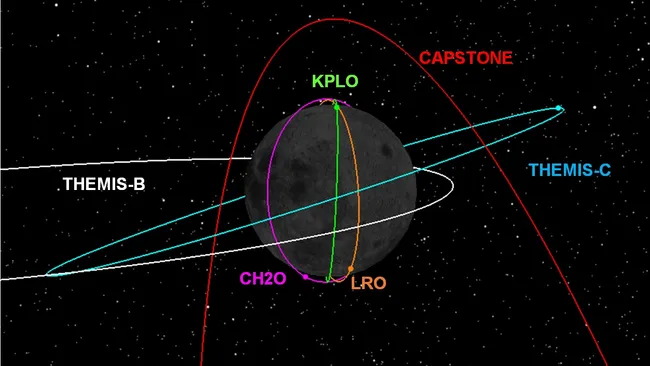
For decades, Space Situational Awareness (SSA) and Space Traffic Management (STM) have been overwhelmingly Earth-centric fields (Frueh et al., 2021; Doucette et al., 2024). Tracking networks and operational safety protocols were natively designed to manage satellite traffic orbiting tightly from Low Earth Orbit (LEO) up to Geosynchronous Orbit (GEO). However, a rapid paradigm shift is underway as humanity extends a permanent robotic and scientific footprint into cislunar space—the vast orbital region influenced by both Earth and lunar gravity (Frueh et al., 2021). With an accelerating influx of international missions targeting the Moon, once-vacant lunar pathways are rapidly transforming into active operational corridors. A historic close-approach event in October 2021 between India’s Chandrayaan-2 Orbiter (CH2O) and NASA’s Lunar Reconnaissance Orbiter (LRO) served as a profound wake-up call, proving that orbital congestion and collision risks are no longer unique to Earth (SpaceNews, 2021).
The October 2021 Conjunction: A Deep-Space Case Study
In mid-October 2021, space tracking analytics generated an alarming deep-space orbital forecast: India’s CH2O and NASA’s LRO were projected to experience a critically close conjunction on October 20, 2021, at 05:45 UTC (The Morung Express, 2021). The hazardous encounter was mapped specifically near the Lunar North Pole (ISRO, 2021). Because both spacecraft operate in polar lunar orbits, their flight paths naturally intersect over the poles on a regular basis, creating recurring spatial cross-overs (ISRO, 2021).
Independent and collaborative risk assessments conducted over the span of a week by the Indian Space Research Organisation (ISRO) and NASA’s Jet Propulsion Laboratory (JPL) revealed remarkably tight margins (SpaceNews, 2021). The orbital models predicted that the total overarching distance between the two moving assets would shrink to approximately 3 kilometers, with a critical radial separation of less than 100 meters (ISRO, 2021). Given the extreme orbital velocities of lunar spacecraft, these tolerances left zero room for error (The Morung Express, 2021).
To mitigate the hazard, ISRO executed a propulsive Collision Avoidance Maneuver (CAM) with the Chandrayaan-2 Orbiter on October 18, 2021—approximately 40 hours prior to the predicted encounter (ISRO, 2021). Post-maneuver orbit determination tracking confirmed that the burn successfully expanded the radial separation during the cross-over, eliminating the immediate collision threat (SpaceNews, 2021).
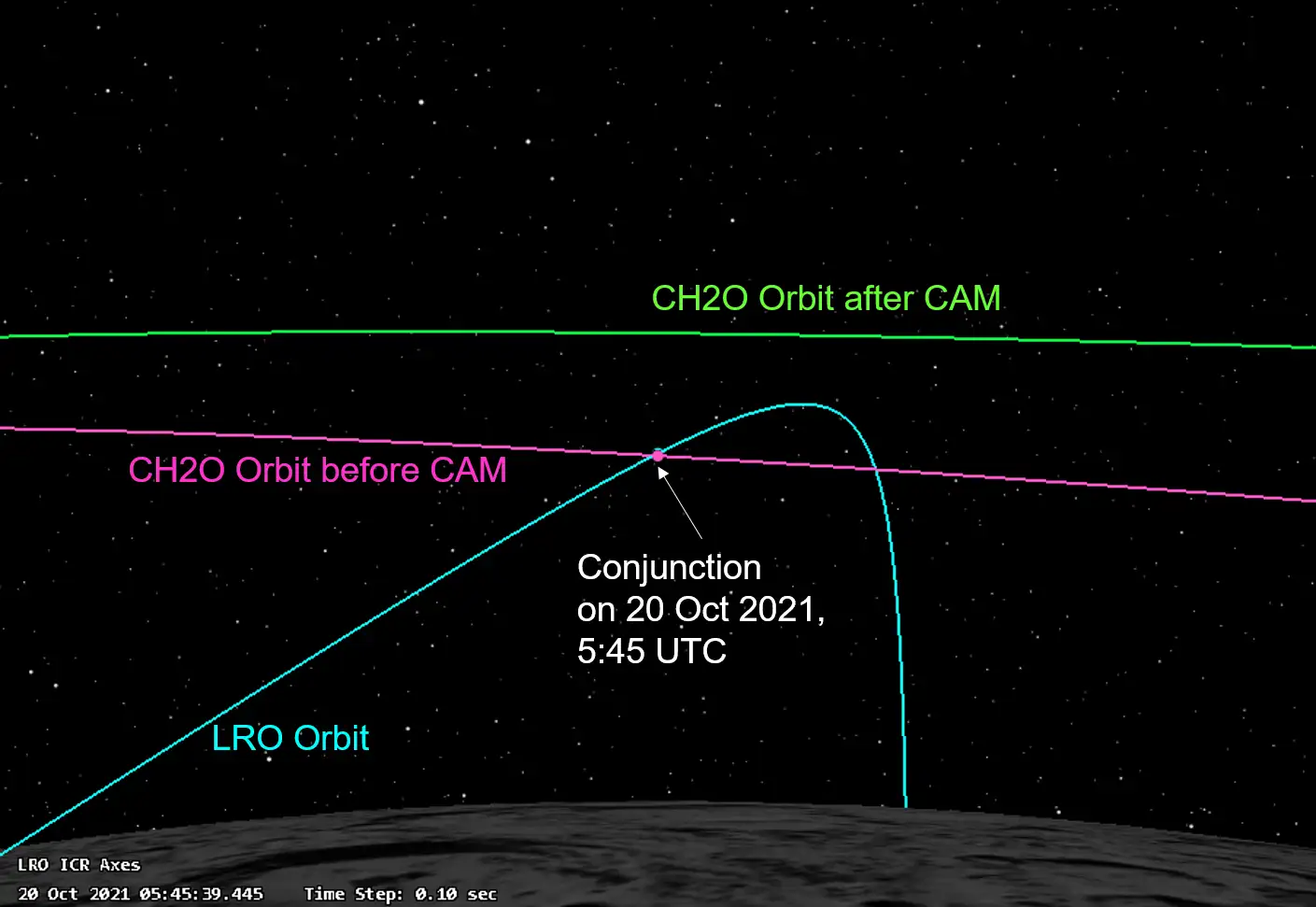
While collision avoidance is a weekly, routine practice in congested Earth orbits, this event marked a significant milestone: it was the first time ISRO was forced to execute an evasive maneuver for an active exploration asset beyond Earth orbit (ISRO, 2021).
The Escalating Traffic Jam in Low Lunar Orbit
Far from being an isolated historical incident, orbital proximity events are quickly becoming a frequent operational headache in the cislunar domain. As more international actors enter the lunar environment, the overlapping polar tracks are triggering an unprecedented volume of orbital friction (SpaceNews, 2024).
A prominent example occurred in September 2024, when the Chandrayaan-2 orbiter was once again forced to perform a propulsive maneuver—this time to lift its orbit and avert a close-approach with South Korea's Danuri (Korea Pathfinder Lunar Orbiter) spacecraft (SpaceNews, 2024). Just weeks later, on October 1, 2024, Chandrayaan-2 performed subsequent path corrections to navigate safely through a dense conjunction window involving multiple lunar vehicles, including NASA's LRO (SpaceNews, 2024).
The sheer density of the traffic is illustrated by data from the Korea Aerospace Research Institute (KARI), which reported receiving roughly 40 "red alarms" highlighting high-risk collision trajectories among LRO, Chandrayaan-2, and Danuri within just an 18-month window (SpaceNews, 2024). Danuri itself has had to maneuver at least three times since entering orbit in late 2022 to evade LRO, Chandrayaan-2, and Japan's SLIM (Smart Lander for Investigating Moon) robotic spacecraft (SpaceNews, 2024).
Why Cislunar Awareness is a Distinct Technical Challenge
The repeating patterns of near-misses highlight a growing structural reality: low polar lunar orbits are becoming crowded with high-value scientific assets, yet managing traffic in this environment requires entirely different expertise and tools than traditional near-Earth operations (Frueh et al., 2021). Cislunar Space Domain Awareness (SDA) is plagued by unique technical, environmental, and diplomatic hurdles:
- Complex Multi-Body Dynamics: Unlike Earth-dominated orbits where Keplerian motion is the baseline rule, cislunar trajectories are governed by highly non-linear, non-Keplerian dynamics driven by the combined gravitational forces of the Earth, Moon, and Sun (Frueh et al., 2021).
- Severe Uncertainty Growth: Because of these complex multi-body interactions, tracking errors grow rapidly and result in highly non-Gaussian state distributions (Iannamorelli & LeGrand, 2025). This makes precise tracking and long-term conjunction forecasting exceptionally difficult over extended tracking gaps (Iannamorelli & LeGrand, 2025).
- Observation Gaps and Geometry Limitations: Ground-based tracking architectures suffer from severe Dilution of Precision (DoP) because terrestrial sensors view the vast cislunar volume from a tightly clustered baseline on Earth (Doucette et al., 2024). Furthermore, tracking assets over the Moon is regularly disrupted by long measurement gaps spanning days or weeks, alongside periodic occultations and solar blinding (Doucette et al., 2024).
- Absence of Centralized Governance: Unlike Earth orbits, which feature mature tracking clearinghouses, there is currently no formal international mechanism or regulatory protocol to resolve cislunar collision risks (SpaceNews, 2024). Operations rely strictly on voluntary, ad-hoc coordination (SpaceNews, 2024).
The Path Forward: Interagency Synergy and Proactive Governance
The successful resolution of these lunar conjunctions has not been a product of automated traffic systems, but rather a victory for voluntary, direct international cooperation (ISRO, 2021). To manage the risks, NASA, ISRO, and KARI actively leverage the MADCAP (Multi-Mission Automated Conjunction Assessment Program) platform provided by NASA's Jet Propulsion Laboratory to map risks (SpaceNews, 2024).
However, informal emails and emergency teleconferences are an unsustainable approach to long-term traffic control (SpaceNews, 2024). Space agencies have noted that network security firewalls, missing contact directories for critical personnel, and administrative friction frequently threaten emergency notifications (SpaceNews, 2024).
As commercial enterprises and national space programs aggressively scale up lunar exploration missions, the probability of catastrophic spatial "traffic jams" will rise exponentially (The Morung Express, 2021). These ongoing close-approach events serve as definitive case studies proving that robust, proactive Cislunar Space Situational Awareness and a mutually agreed-upon information-sharing framework are no longer theoretical exercises for the distant future (Frueh et al., 2021; SpaceNews, 2024). They are immediate operational prerequisites required to maintain the safety, transparency, and long-term sustainability of the new lunar frontier (ISRO, 2021).
References
- Doucette, S. G., Raub, K. T., Mandeville, W. J., & McLaughlin, T. A. (2024). Automating Motion Hypothesis Methods for Cislunar Satellite Discovery. Advanced Maui Optical and Space Surveillance Technologies (AMOS) Conference.
- Frueh, C., Howell, K., DeMars, K. J., & Bhadauria, S. (2021). Cislunar space situational awareness. 31st AIAA/AAS Space Flight Mechanics Meeting, AAS 21-290.
- Iannamorelli, J. L., & LeGrand, K. A. (2025). Adaptive Gaussian Mixture Filtering for Multi-sensor Maneuvering Cislunar Space Object Tracking. The Journal of the Astronautical Sciences, 72(51).
- ISRO. (2021). Chandrayaan-2 Orbiter - Information on Collision Avoidance Manoeuvre. Indian Space Research Organisation Mission Archive.
- SpaceNews. (2021). India’s Chandrayaan-2 maneuvered to avoid close approach to NASA’s Lunar Reconnaissance Orbiter. SpaceNews Editorial.
- SpaceNews. (2024). India's Chandrayaan-2 moon orbiter avoids collision with South Korea's Danuri spacecraft. SpaceNews / Space.com.
- The Morung Express. (2021). India’s Chandrayaan-2 avoids collision with NASA’s Moon orbiter. MorungExpress News.